Hello everyone, I'm Linda Klabunde. Wife of Larry and daughter-in-law of Elmer and Lenora (Sass) Klabunde. Both of their families have lived in the Bennington area since around 1887 (more or less).
When we were going tho Lenoras things we ran across a dozen scrap books with newspaper articles dating back to the 1930's. Gordon and I thought you might like seeing some of these. So if you like what you see and your family should happen to have any articles or photos (with names please) shoot me and e-mail andI'd be happy to scan them and add them to our history.
Thank you and I hope you enjoy reading these.
Linda lcstonzfan@gmail.com
Monday, November 26, 2012

Friday, November 23, 2012
Bennington Celebrates 125 Years!
The Bennington Historical Society celebrated the 125th Anniversary of Bennington's founding on November 18 at the Library Community Room in Bennington. Bennington's town site was dedicated November 15th, 1887. The celebration included an open house that featured historical displays, artifacts, refreshments and a presentation. Approximately 40 attended.
Guests were treated to displays featuring a presentation of founding family names, artifacts from the Bunz family, old photographs of town, artifacts found at the Bennington Roller Mill site, and maps showing ownership of lands and City lots.
A power point presentation entitled; "What and Who was Here Before Bennington?" was given at 1:30 and 2:15. The presentation featured a summary of the Great Plains landscape, the forces which shaped its settlement by humans and how the local area became one of the most important travel corridors for Westward expansion.
Bennington is located within 10 miles of river boat traffic which traveled up the Missouri River as far west as Montana; the Mormon trail where pioneers traveling by wagon trail came through this area and the Union Pacific Railroad which laid its tracks just 10 miles to the south of us that completed the Transcontinental Railroad in 1869.
A good time was had by all.
 |
| Guests and refreshments at Bennington's 125th Celebration |
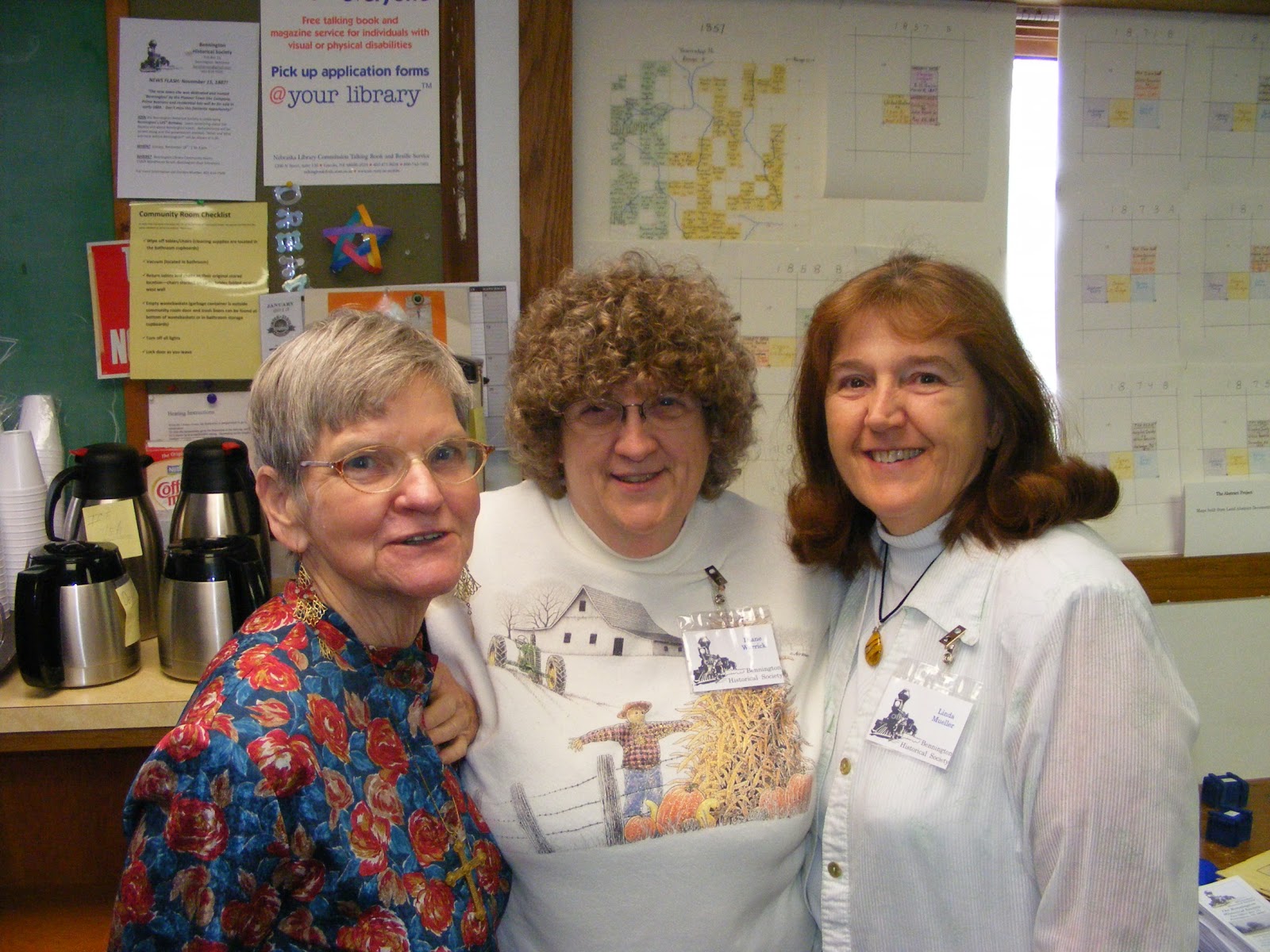 |
| Society Members: Julie Dunn, Diane Warrick, and Linda Mueller |
 |
| Society Members; Clarence Laaker, Jan and Bob McKelvie, Ginger McGurk and Linda Klabunde |
A power point presentation entitled; "What and Who was Here Before Bennington?" was given at 1:30 and 2:15. The presentation featured a summary of the Great Plains landscape, the forces which shaped its settlement by humans and how the local area became one of the most important travel corridors for Westward expansion.
Bennington is located within 10 miles of river boat traffic which traveled up the Missouri River as far west as Montana; the Mormon trail where pioneers traveling by wagon trail came through this area and the Union Pacific Railroad which laid its tracks just 10 miles to the south of us that completed the Transcontinental Railroad in 1869.
 |
| Gordon Mueller presenting "Who and What was here Before Bennington?" |
Monday, October 15, 2012
Quest Speaker from the Durham Museum
Carrie Wieners, curator of The Durham Museum in Omaha, visited the Society on October 18, 2012. She came and briefed members on the proper methods of preservation and storage of historical items. We discussed in depth the need for accurate record keeping in terms of retrieval, research, and the legal responsibility.
Society members brought items from home and received advise from Carrie on the best ways to preserve and store them. They included glassware, pottery, china, paper items, textiles, leather and metal goods. It was an interesting evening and everyone agreed to have similar speakers attend.
 |
| Carrie Wieners and Society member Lois Musel examining a century old German uniform |
Sunday, September 16, 2012
 |
| Washington, Nebraska celebrates its 125th birthday! |
Washington, Nebraska celebrated its 125th birthday last weekend. The town had an ice cream and home-made pie social, tour of the historic business sites, displays and activities for the kids. It was a fun time and I had a piece of rhubarb-strawberry pie that was to DIE FOR!
 |
| Model of Washington's Business District |
Not many people realize that Washington and Bennington are "Twin Sister Cities." That's right; in 1887 the Chicago Northwestern Railroad laid track through the Papio Creek Valley. They started at Arlington, and laid track south to Irvington and during the process created two new railroad towns: Washington and Bennington.
There seems to be some confusion in Bennington regarding when our 125th birthday is. The sign on the City Office reads 'Established 1892' and the City celebrated the Centennial or our incorporation (1892) in 1992. What happened to Bennington's real birthday?
The truth is that the Bennington Town Site was dedicated November 15th, 1887. Construction on the business district started shortly afterwards. By those standards, Washington should have waited until 2015 to celebrate its Centennial let alone its Quasquicentennial. You see, Washington grew much slower and didn't incorporate until 1915. That means they should have waited until 2040 to celebrate their 125th!
Thank God they didn't because I would have missed that pie and a great time! Happy Birthday Washington!!!!!!
Dig into our local history and find the real truth!
Thursday, September 13, 2012
Mystery Item

Clarence Laaker brought this item to the last Historical Society Meeting for show and tell. The questions is; What is it? It has a handle on one end, a wire cage tube that extends down the side and spade and foot on the other end. Someone suggested it was an early golf ball picker-upper. Could they be right? What do you think? Answer in 2 weeks.
ANSWER: A potato planter. Potatoes were planted in tilled soil so it was easier to plant and for the potatoes themselves to grow. The seed potatoes were stacked in the wire tube. Each had to have at least one good "eye" to sprout. The planter was pushed into the loose soil and further inserted by stepping on the foot lever. Once inserted, the handle was cranked down which dropped and inserted one potato in the ground. Extract and move on. The marvels of modern agriculture!
Wednesday, August 29, 2012
Bennington during the War Years: 1941-1945
The Society has started posting displays in the window of Bob McKievers building. Swing by and check them out. Here is part of one:
Bennington use to be a self sufficient town. There were a large number of downtown businesses and folks had a little reason to run into Omaha or Benson for anything. Actually, travel during the war was discouraged because of the war effort and gas rationing.
Bennington use to be a self sufficient town. There were a large number of downtown businesses and folks had a little reason to run into Omaha or Benson for anything. Actually, travel during the war was discouraged because of the war effort and gas rationing.
Darrell Logeman came across an old box of Clover Leaf Grocery Store receipts and gave them to us. That store was operated by Roy Gordon and his daughter Jeanette. The box was like a time capsule, showing businesses, services and costs of things 7 decades ago. A lot of things have changed: For instance you only had to dial 4 numbers to make a phone call. Today, we have to dial 10, but then again, everyone has a cell phone. A dollar went a long ways in those days compared to today. A candy bar or soda cost a nickel rather than a dollar and a gallon of rationed gas cost $0.20. Here are some of those receipts and examples:
Special Tax Stamp –“Retail Dealer in Uncolored Oleomargarine” In the old days people used real creamery butter. Just prior to the war oleomargarine was introduced as a substitute for butter. It was something “new” and even the IRS got a piece of the action by taxing its specific sale. It resembled lard when sold but came with a yellow coloring agent that when blended made it look more butter. White oleomargarine was sold well into the 1960’s due to the efforts of the dairy industry in some states. They probably thought the inconvenience of having the buyer color the margarine helped butter sales.
The Idea Gas Station. That gas station was owned by Chet Witte and was located (15417 S. 2nd Street) on the south east corner of Warehouse, Stark and Main Street. We complain about gas prices now but in those days the issue was simply getting gas ration stamps that allowed you to purchase it. Receipts suggest 5 gallons of gasoline was purchased each week at the cost of $1.00.

In those days, station owners also made deliver of fuel oil and gasoline to residences and farms. The old fuel oil tanks typically held 300 gallons. One receipt showed a delivery of 260 gallons cost a little over $21. That is 8 cents a gallon!
C.W.Hadan had a plumbing, heating and electrical business at 15313 S. 2nd Street called “Modern Utilities.” It’s probably safe to speculate that Bill helped every home owner and business in this City. His business was eventually bought by John M. Grant who operated the store with his wife “Snooky” into the 1970’s. John charged $3.00 for a business call during the war.
The street up by Cubby’s is named in honor of Bill’s contribution to this community. His original building still stands but has been converted into an apartment building.
Chicago and North Western Railways Co. The majority of shipping and much personal travel was done by train. The depot was a busy place. What you couldn’t find in town could be ordered and shipped in by train. One receipt showed that nearly 500 pounds of fence wire was bought and delivered to the Bennington Depot. The delivery cost was 70 cents per hundred weight.
Neumeyer Farm Equipment Co. Hans Neumeyer’s had a Case implement and parts dealership located in what was previously the old Petersen Garage. It was found at 15415 S. 2nd Street and no longer survives. A new building was built by Miles and Nelson that house apartments now. You can see the Case Implement sign over the gentleman’s shoulder.
 |
| The Case Implement Dealership sign can be seen in the background. |
Clearvue Dairy. A lot of farmers supplemented their income by milking. Nearly everyone had a few milk cows that produced milk for the family and surplus milk, cream and butter was sold in town. Several herds expanded into full fledge dairy operations. Having a milk herd was a lot of work; demanding the cows be milked both in the morning and evening 7 days a week. We believe this dairy was located a little more than a mile west of Bennington and it was owned and operated by Otto Leppert. Otto sold (wholesale) his milk for $0.64 a gallon.
 |
| Hauling milk in cans to town. |
Farmers Union CO-OP. Merc. CO. The Farmers CO-OP was located on the east side of the bank building (15322 S. 2nd Street). They sold agricultural supplies and equipment. They also had a lot on Warehouse Street where they received and stored coal, kerosene, gasoline and other bulk materials from the railroad. A great number of homes and businesses at that time were heated with coal and fuel oil. We learned that a ton (2,000 lbs) of delivered coal cost $12.75.
 |
| Bennington's Farmer's Union |
Clover Farm Store The Clover Farm (Bennington) Food-Center was a nationally operated franchise. Bennington’s was located on the southwest corner of Stark and Main Street. It was operated by Roy Gordon. After the war the franchise was changed to IGA (Independent Grociers Association). Farmers would commonly trade produce for groceries or sell produce for cash. In September, Fred Werner sold 379 lbs of melons to the store for $13.26. That’s three and half cents a pound.
Nebraska Power Company was the predecessor to Omaha Public Power District. Clover Farm Store had a large freezer plant. This was at a time when individual freezers were both expensive and rare. Most residence rented a box at the store to keep their frozen foods. Power demand was high. In June, the bill was $4.91!
Bennington Transfer. Hans Neumeyer owned a trucking company in town that was located at 15520 Warehouse Street; across from the Library. The original building still stands. The transfer company hauled milk and would make scheduled trips to Omaha picking up goods for local businesses. This receipt suggests they picked up meat and paper goods for the store.
 |
| Bennington Transfer making another delivery. |
Have old pictures or artifacts you’re willing to share? Give the Historical Society a call: 402-614-7509 or come to our meetings.
Thanks
Photographs, courtesy of Marvin Tiedje and others.
Monday, July 23, 2012
Omaha Exposition of 1898
Lois (Mohr) Musel brought a souvenir that one of her family members had gotten at the Omaha Exposition of 1898. The 'cranberry goblet has "Exp. 98" etched into it and "John Mohr." Another Society member brought a similar goblet she had bought off e-bay that had "Walt Mangold" inscribed on it. Walt was a Post Master here in town. The cups are over a century old and mark a very important celebration that put this part of the country on the map.
Check it out!
The Trans-Mississippi and International Exposition was a world's fair held in Omaha, Nebraska from June 1 to November 1 of 1898. Its goal was to showcase the development of the entire West, stretching from the Mississippi River to the Pacific Coast. The Indian Congress was held concurrently. Over 2.6 million people came to Omaha to view the 4,062 exhibits during the four months of the Exposition. President William McKinley and William Jennings Bryan were among the dignitaries who attended at the invitation of Gurdon Wattles, the event's leader. 100,000 people assembled on the plaza to hear them speak. The Expo stretched over a 180-acre (0.73 km2) tract in North Omaha and featured a 2,000 feet (610 m)-long lagoon encircled by 21 classical buildings that featured fine and modern products from around the world.
Check it out!
 |
| "Exp. 98" |
 |
| "John Mohr" |
The Trans-Mississippi and International Exposition was a world's fair held in Omaha, Nebraska from June 1 to November 1 of 1898. Its goal was to showcase the development of the entire West, stretching from the Mississippi River to the Pacific Coast. The Indian Congress was held concurrently. Over 2.6 million people came to Omaha to view the 4,062 exhibits during the four months of the Exposition. President William McKinley and William Jennings Bryan were among the dignitaries who attended at the invitation of Gurdon Wattles, the event's leader. 100,000 people assembled on the plaza to hear them speak. The Expo stretched over a 180-acre (0.73 km2) tract in North Omaha and featured a 2,000 feet (610 m)-long lagoon encircled by 21 classical buildings that featured fine and modern products from around the world.
Subscribe to:
Posts (Atom)